History · Chapter 4 of 10
Christian Heritage
How a riverside trading village became a Christian parish, split into two rival churches for almost seventy years, and came back together in 1964 under one roof, the St. Thomas Church we know today.
Kerala’s Christians trace their faith back to the apostle St. Thomas, who, according to an old and much-loved tradition, landed on this coast in the first century. Palayur, north-west of Thrissur, is one of the places linked with him. The families who built up Aranattukara’s Christian community carried that tradition with them.
The Tharakans and the first settlers
The book traces the story to the Chiramel family, the future Tharakans. They are said to have moved from Palayur to Chendamangalam, then to Pazhuvil, and finally to Aranattukara to trade, probably in the late fifteenth century. Their land, trade and standing at the Cochin court drew other Christian families, boatmen and labourers to settle around them. By the time of Sakthan Thampuran, whose warehouses made the kadavu (landing) a busy port, Aranattukara had become, in the book’s words, a Nazrani village.
Before there was a church
For a long time the village had no church of its own. Its people belonged to the parish of Pazhuvil. On Sundays and feast days a few of them went there by canoe and came back to the Aranattukara landing by noon. Those who had stayed behind waited at the water’s edge to receive the kaisthuthi, the folded-hand greeting “Praise be to Jesus Christ”, and they carried it home to the sick and the old. In time the wish for a church of their own became pressing.
The first church, 1796
That wish was granted through the king. The book records that Sakthan Thampuran, who favoured the Christian traders, issued a royal order (thittooram) giving dry land belonging to the Vadakkunnathan temple for a church. Permission for a new parish was obtained from the church authorities at Kodungallur, and in 1796 Paremmakkal Thoma Governador blessed Aranattukara’s first church, dedicated to Our Lady of the Holy Rosary.
The statue that came by salt boat
Sakthan Thampuran made salt a state trade and centred its storage at Aranattukara. Christian boatmen rowed large cargo boats (pathemari) to Kozhikode to fetch it, a round trip of about two weeks.
According to a tradition preserved by C.T. Antony, one such crew, held up at Kozhikode by a storm, went looking for a church to pray in. They found one partly ruined during Tipu Sultan’s campaigns, and inside it an undamaged statue of St. Sebastian. They wrapped it in cloth and brought it home on top of the salt. The story says the vicar had already seen its arrival in a dream, and that the parish met the boat with palm leaves, white cloth and mats laid all the way from the landing to the church. The book dates this to between 1800 and 1805. People have prayed to St. Sebastian here ever since, especially for protection from epidemics, and his feast in January is still the village’s great celebration.
A wider quarrel: the Mellus years and Bishop Medlycott
In the 1870s the Thrissur church was badly divided. Bishop Mellus, sent from Baghdad without the Pope’s approval, won over the Thrissur Big Church and many nearby parishes. The book says the Tharakan of Aranattukara kept his own parish loyal to Rome, and tells how the Tharakan’s horse carriage once smuggled Mellus’s assistant bishop out of Thrissur to Elthuruth, from where he left for home. Mellus himself left Kerala in 1882.

In 1887 Rome created a new Vicariate of Trichur and appointed Adolph Medlycott as its head. The Thrissur church he should have used was still held by the breakaway group, so he stayed at the Elthuruth ashram on Aranattukara’s western edge. The book proudly notes that the Tharakan’s carriage brought him there. During the same quarrel, five Aranattukara families who refused to follow Mellus built a small chapel near the big church in Thrissur town; the present Latin church stands on its site.
Two churches, 1896
At home, a different crack was widening. The old Syrian Christian families would not treat newer arrivals as equals, and feast-day honours became a constant cause of friction. The book tells of a gold cross seized from the church during a feast, and of open fights.
In the end the newcomers bought 1 acre and 69 cents of land at a government auction, right in front of the old church, and with Bishop John Menachery’s permission completed a second church in 1896, dedicated to St. Sebastian. The statue from Kozhikode went with them. The old church became the Kizhakke Palli (East Church), the new one the Padinjare Palli (West Church), and the parish was split in two.
The split reached into everything. In 1940–41 a wedding between a young woman of the East Church and a young man of the West Church became a months-long stand-off. The church was locked and guarded for weeks, and on 3 March 1941 the Bishop of Thrissur, Francis Vazhappilly, was kept out of the church altogether. He prayed instead at the wayside chapel in Valiyangadi, which the book links with today’s St. Mary’s Chapel. The wedding was finally blessed under police protection. The bitterness lasted another quarter of a century.
The long road back
Healing began in small, practical ways. Children from both churches sat side by side at St. John’s School, Tharakan’s School and the Infant Jesus Girls’ School, and grew up as classmates rather than rivals. Five men, C.R. Devassy Master, Mathew Tharakan, Chakkoru Master, Kaithakkodan Joseph Master and Payankan P.P. Mathew, worked so steadily for peace that opponents mocked them as the “Pancha Pandavas” (the five Pandava brothers of the Mahabharata). Chakkoru Master and friends opened a tennis court for everyone behind the East Church, and in December 1941 started a Catholic Truth Society that argued for peace through pamphlets.
Sport and drama did the rest. The two vicars, Fr. Jacob Chovvalloor at the East Church and Fr. Jacob Chalakkal at the West, encouraged clubs where young men of both parishes played volleyball and ring tennis together, while football teams and the Romulu Theatres drama group gave them other shared causes. In March 1964 the West Church’s sports club held a reception for two newly ordained priests from the East Church. Hardly anyone realised it was a first step towards reunion.
One parish again, 1964
On 3 July 1964 Bishop George Alappatt, answering the people’s own request, united the two parishes into one. Both old churches were to be pulled down and a single new church built for the apostle St. Thomas.
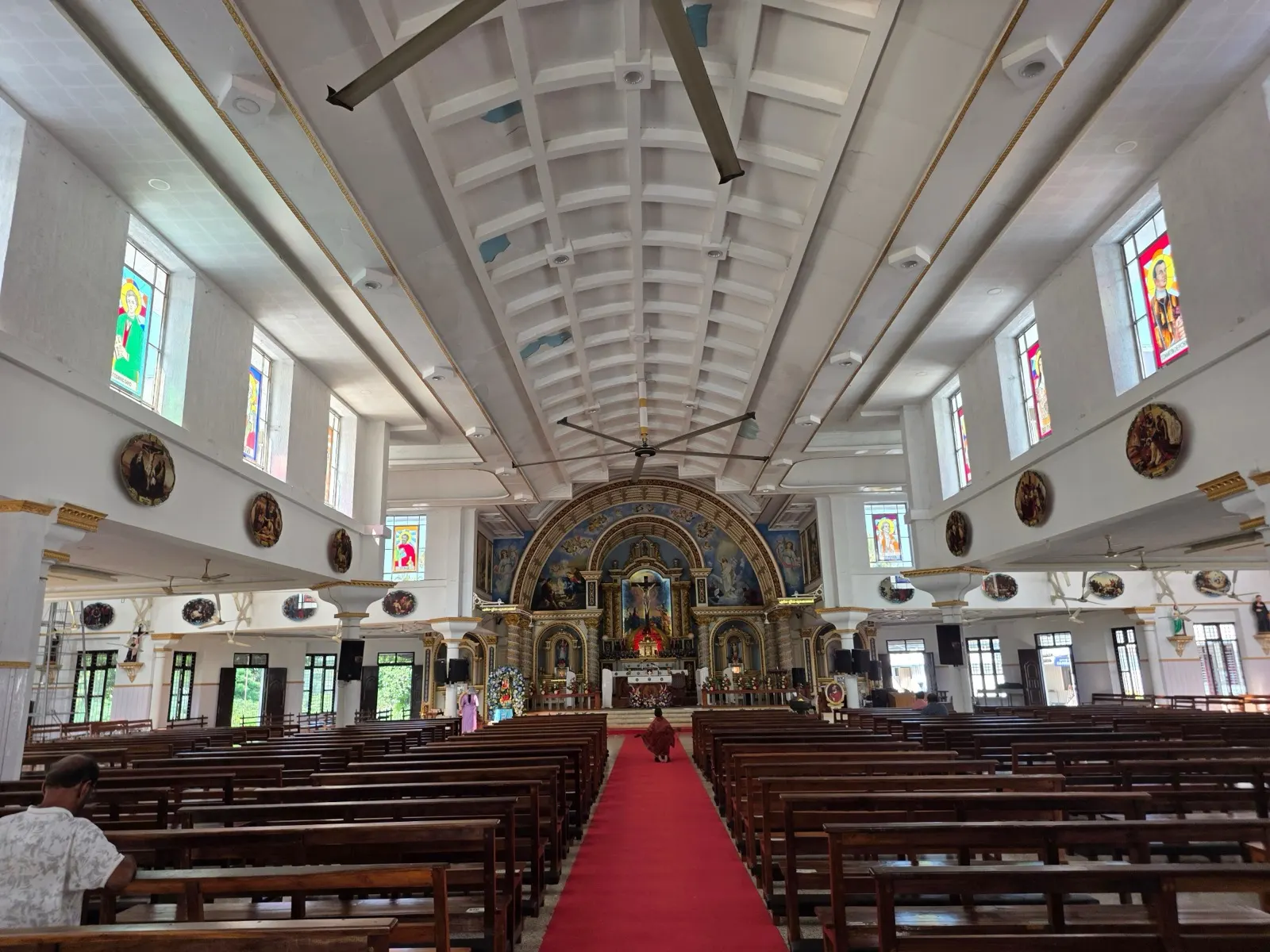
The money came slowly, from land sales, gifts and even a concert by Yesudas. Architect Samuel John, with N.J. Kuruvila and K.C. Alex, drew a cross-shaped plan, and local engineer Thomas Chiriyankandath oversaw the work. On 6 January 1973 Mar George Alappatt blessed the new St. Thomas Church. The book says many people wept as the choir sang, remembering the years when they had stood apart.
The 2015 renovation
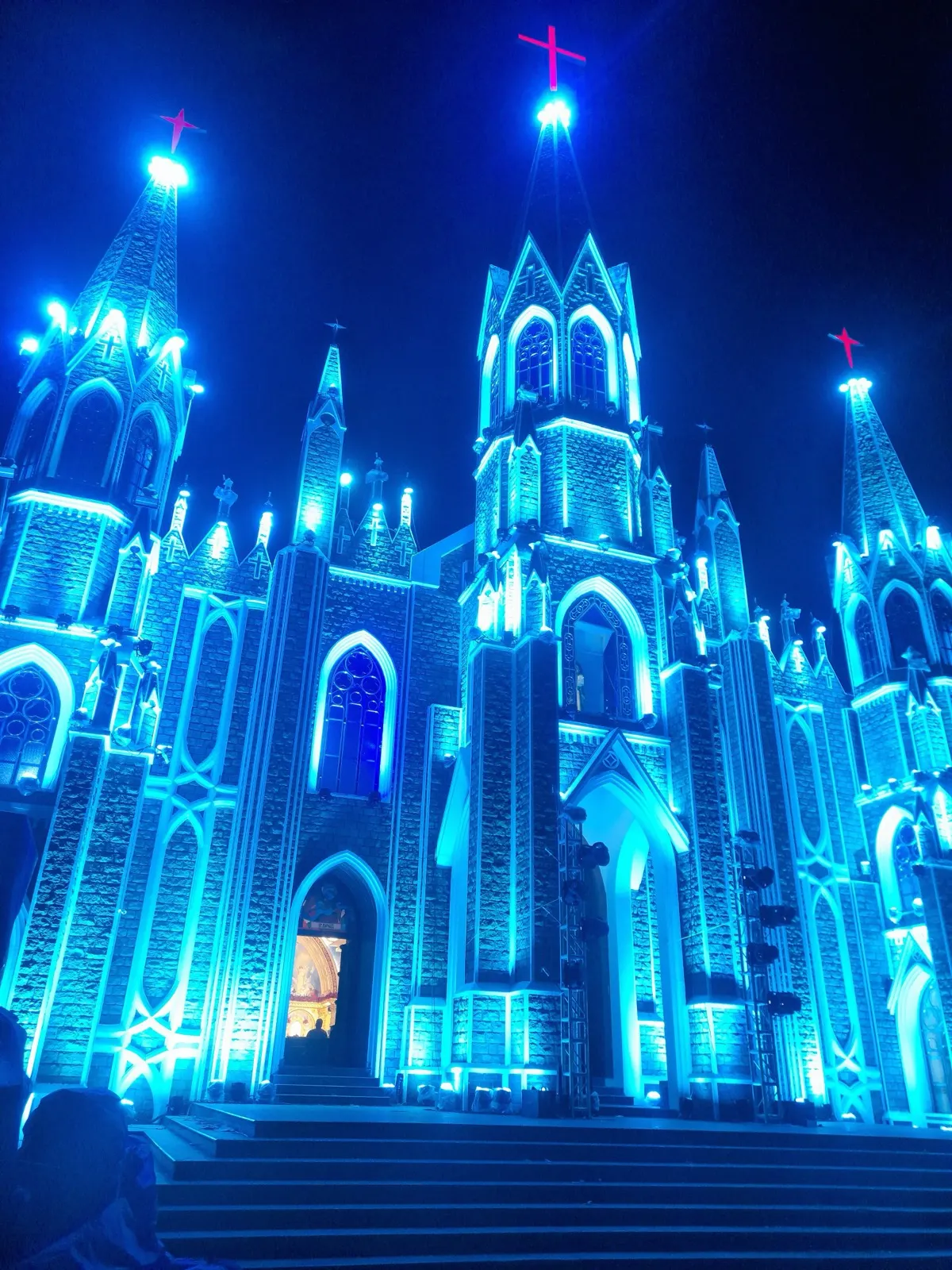
As the parish grew, the 1973 church became too small. Under the vicar Fr. Joseph Anthikkad the parishioners rebuilt it: the flat front became a cluster of Gothic-style spires, the nave was widened on both sides, and the altar was redesigned to show Christ’s birth, death and resurrection. Mar Andrews Thazhath, Archbishop of Thrissur, blessed it on 1 May 2015. This is the church that lights up every January for the perunnal (feast).

Sources
- Joy Chiramel, Arranadu – Aranadu – Orunadu (2024), ch. 3, ch. 9 and ch. 11
- C.T. Antony, Oonnuvadikal (as cited in Chiramel, ch. 3 and ch. 9)
- Fr. Antony Jees, Swathanthra Vidyabhyasathinte Acharyan, Part One (as cited in Chiramel, ch. 3)
Places and people in this story
St. Thomas Church, Aranattukara
The parish church at the heart of Aranattukara, whose story runs from a first church in 1796, through a long division, to reunion in 1964 and the church we see today.
St. Mary's Chapel, Valiyangadi
A wayside chapel in the middle of Valiyangadi, at Fatima Corner, rebuilt more than a hundred years ago with what is said to be Aranattukara's first concrete beam.
Elthuruth Ashram
The Carmelite monastery founded in 1858 by St. Kuriakose Elias Chavara on an islet at the western edge of Aranattukara parish.

Tharakan's School, Aranattukara
The parish school beside St. Thomas Church, which grew from a village writing school into Tharakan's High School and taught generations of Aranattukara children.
Infant Jesus Girls' High School
Aranattukara's girls' high school, run by the Holy Family sisters since 1950, long known for strong results and a nationally honoured headmistress.

Sakthan Thampuran
The Cochin ruler (1790–1805) who made Thrissur his capital and turned the Aranattukara landing into a centre of state trade.