
History · Chapter 6 of 10
The Schools That Shaped Aranattukara
From village writing schools taught by Hindu teachers to Tharakan's School, the girls' high schools and St. Aloysius College at Elthuruth, this is how Aranattukara learned to read, and how its classrooms helped heal a divided parish.
Tharakan’s School is the name most people link with learning in Aranattukara. But the story is older and wider than one school. It runs from teachers paid in rice to a university campus, and it crosses every community in the village.
Learning before schools
For centuries, education in Kerala meant the gurukula way: a child went to live with a teacher, the Asan, and learned by listening. Some Asans taught a few pupils in their own homes; sometimes the village children simply gathered under a tree.
In the nineteenth century the Carmelite priests of the Syrian Christian church took up education. Their leader, St. Kuriakose Elias Chavara, is remembered for the call “a school for every church”, and parishes across Kerala began to open a pallikkoodam (school) beside the church.
The writing schools
In Aranattukara the first were ezhuthu pallikkoodams (writing schools), one in Valiyangadi and one in the south of Padinjare Angadi. The two market communities paid for them, and the teachers were Hindu Panicker Asans, who taught Malayalam and arithmetic and, because these were Christian schools, the Christian prayers too. They were paid in rice, food and cloth. It is a fine picture of the village: Hindu teachers teaching Christian children their prayers, with the whole community sharing the cost.
St. John’s School
In 1886 an English primary class was started in the Valiyangadi writing school, funded by a group of local families, the Tharakans among them. From August 1890 the Cochin government gave it a grant of three rupees a month and recognised it as an aided school, so children of every caste could now enrol. Boys and girls studied together up to the fourth class.
Then smallpox came. In 1892 the epidemic killed many in the parish, the school moved into the church’s dining hall, and classes stopped altogether. People revived the school in 1900. As numbers grew, Chiramel Antony Tharakan rebuilt it, and in 1907 Bishop John Menachery opened the new building as St. John’s School. When the government raised the standard and the fees for English teaching in 1911, the school could not keep up and became St. John’s Malayalam School. Children who wanted English now had to go to Elthuruth or Thrissur, which poorer families could not afford.
Tharakan’s School
The way back to English came in 1922, when the Director of Education, Rao Sahib Mathai, sanctioned an English school for Aranattukara. In May that year the first three classes began in a building owned by the Padinjare Angadi community. Boys and girls were both admitted, and no fees were charged. The next year the school moved to a building north of the church, and higher classes were added over the following years. There was even a “four-and-a-half” class, a year of extra English for children coming from the Malayalam school.
In 1930, when Fr. Antony Thachuparambil was vicar, Inasu Tharakan handed the school over to the church, and the parish named it Tharakan’s Secondary English School in the family’s honour.

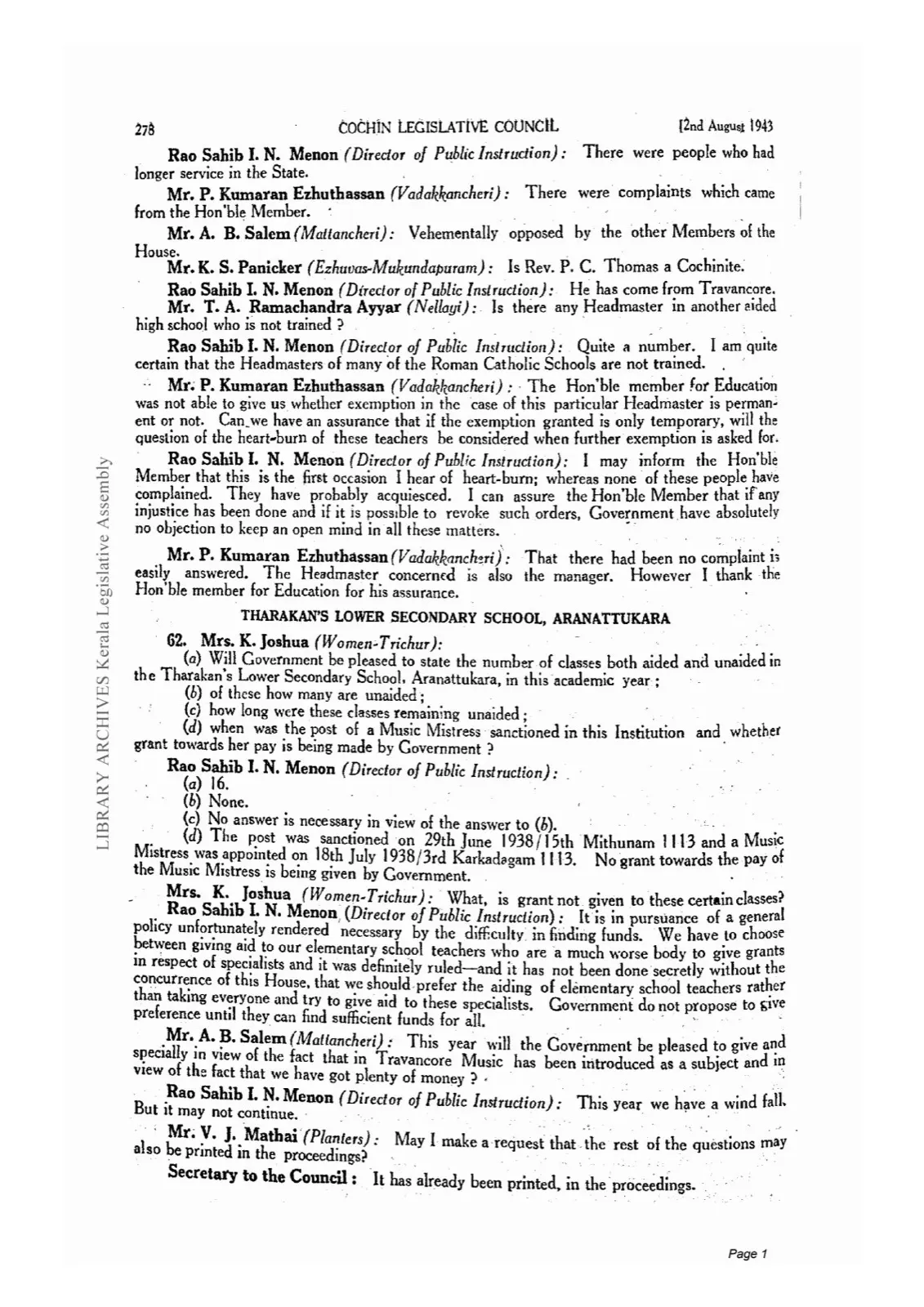
Government records add a few glimpses of school life. In December 1930 a member of the Cochin Legislative Council asked why a teacher, A.C. Lonan, had been relieved from Tharakan’s school after writing a book called Samsayanivrithi. The government replied that the manager had relieved him in June 1930 and the department had approved; it said there had been no pressure from church authorities. In 1943 another member asked about the school’s classes and was told that all sixteen were aided, and that a music teacher had been appointed in 1938, though the government did not pay her salary.
The school became a high school in 1947–48. Its first headmaster has a story the book clearly enjoys. When no graduate could be found to lead it, Chakkoru Master persuaded his only son, A.C. Chiramel, a major in the army, to resign and take the job. After a year, following a complaint by A.J. Paul Master, the department made him headmaster instead, and the former soldier went to the seminary, becoming Fr. Antony Jees and later a headmaster again. In Malayalam, the book notes, the pattalakkaran (soldier) became a pattakkaran (priest).
After Independence St. John’s merged with Tharakan’s, which ran from class one to ten as a boys’ school. The book calls the years under K.I. Iranimose Master, headmaster from 1961, its golden age, crowned by his State Award in 1970. While the parish was split between two churches, children from both sides studied here together, and the book counts the schools among the quiet forces that brought the village back together.
A new building
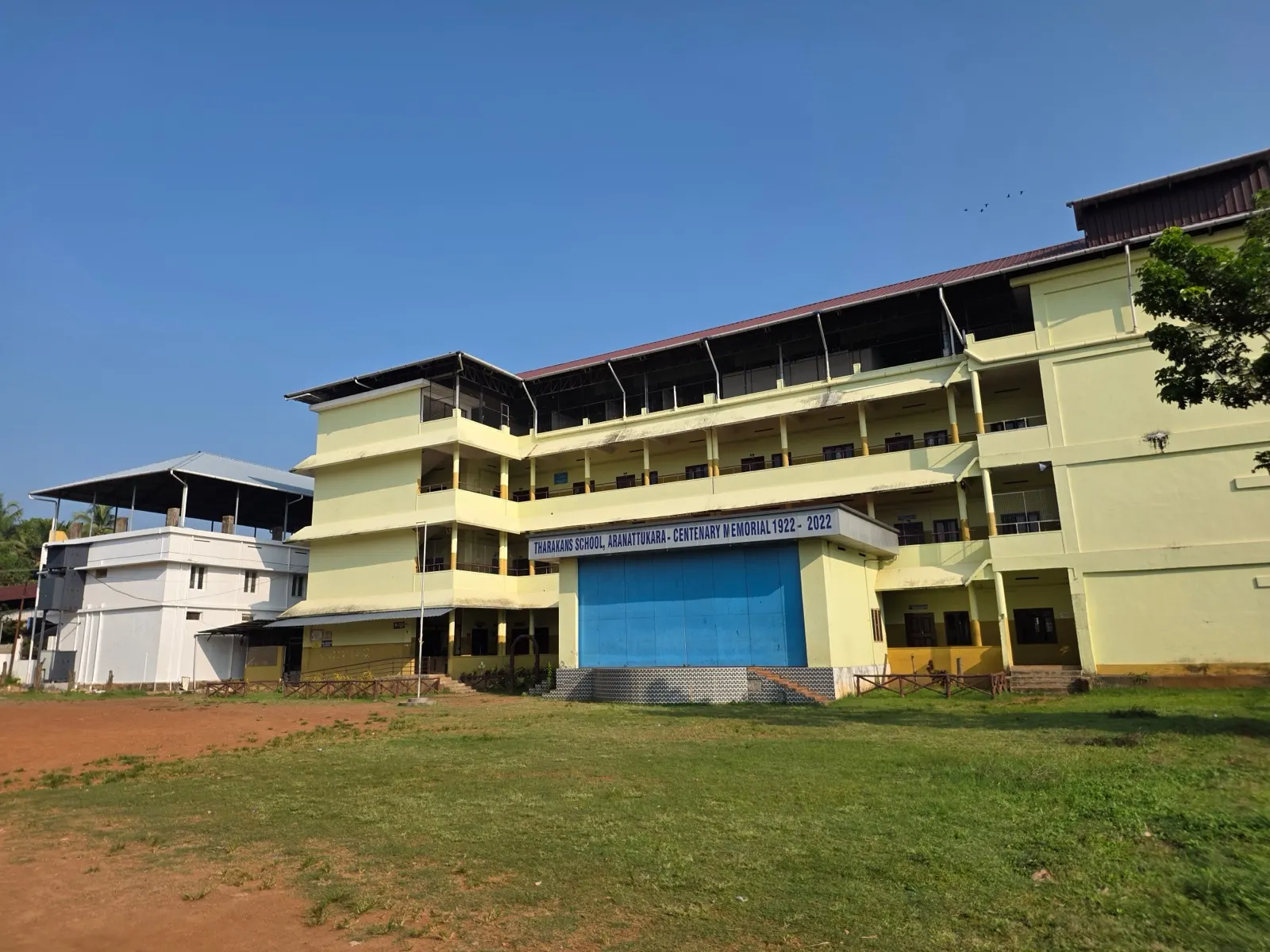
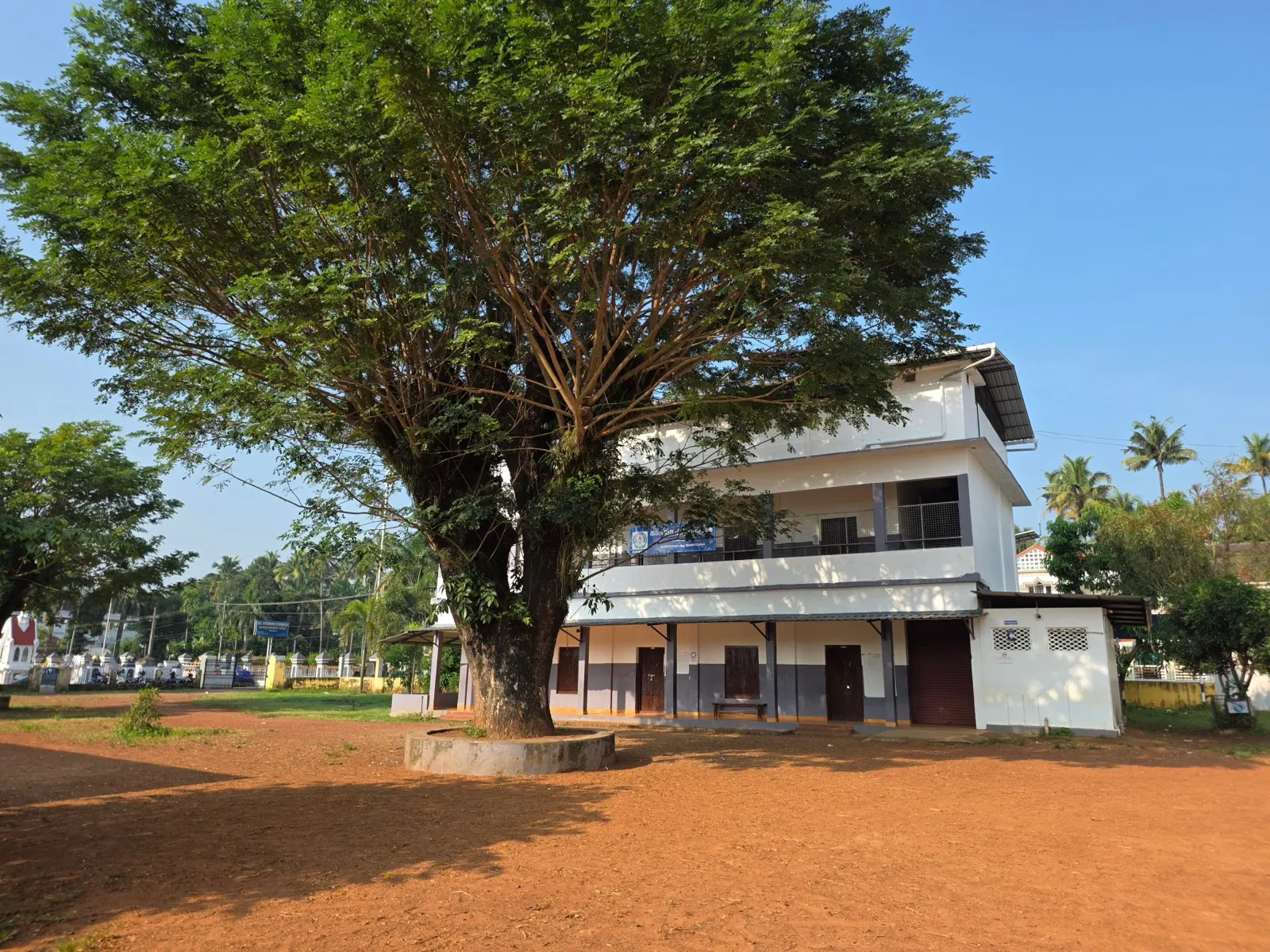
By 2000 the old building was falling behind. Renovation began in 2012 under the manager Fr. Joseph Anthikkad, and under his successor Fr. Babu Panattuparambil the old block was demolished and the high school moved into a new building. The lower primary section moved into a building completed earlier by Therattil J. Antony. Angel Valley, a pre-school that teaches Spanish, opened in the same compound.
Schools for girls, and others
When Tharakan’s became a high school, its girls were handed over to the Holy Family Sisters. Their convent opened on 26 May 1947 in a rented house at Padinjare Angadi, and in 1950 their classes became the Infant Jesus Girls’ High School. Its headmistress, Sister Ezhsala, received the National Teacher Award in 1971. To the north, the CMC sisters founded St. Ann’s Girls’ High School, where Nirmala College for women now also works.
Other schools mattered too. A government Malayalam lower primary school at the northern end of Valiyangadi gave free schooling to poor children and still runs today; it is very likely today’s Government UP School. A second government school at Poothole closed for lack of pupils; the Excise Academy now stands on its site. Chacko Memorial Middle School at Padinjarekotta, run under the Syrian Orthodox Church, was started by John Mathai in memory of a relative, and taught many Aranattukara children at half fees until it closed in the mid-twentieth century. After his death, Mathai’s family gave his home for higher studies, and it is now the Dr John Matthai Centre of the University of Calicut, with its economics department and School of Drama.
Elthuruth and St. Chavara
The village’s link with Elthuruth begins with St. Chavara himself. In 1856, at his request, the vicar of Aranattukara called a meeting in the church courtyard, and parishioners waved their shoulder cloths in the air to show they agreed to help. In 1858 Chavara founded the Carmelite ashram at Elthuruth, on a quiet islet at the parish’s western edge, saying Mass at Aranattukara while the work went on. Two later bishops, Joseph Pastor Neelankavil and Antony Chirayath, came from this parish.

Around 1889 the ashram opened an English middle school for boys, with boarding for students from across Cochin State. It became a high school in 1933, and in the mid-twentieth century the CMI fathers raised it into St. Aloysius College, which still serves students from the western side of Thrissur.
Sources
- Joy Chiramel, Arranadu – Aranadu – Orunadu (2024), ch. 5 and ch. 10
- Fr. Antony Jees, Swathanthra Vidyabhyasathinte Acharyan, Part One (as cited in Chiramel, ch. 5)
- C.T. Antony, Oonnuvadikal (as cited in Chiramel, ch. 5)
- Cochin Legislative Council proceedings, 4 December 1930, question 96 (Kerala Legislative Assembly library archives)
- Cochin Legislative Council proceedings, 2 August 1943, question 62 (Kerala Legislative Assembly library archives)
Places and people in this story
Tharakan's School, Aranattukara
The parish school beside St. Thomas Church, which grew from a village writing school into Tharakan's High School and taught generations of Aranattukara children.
Infant Jesus Girls' High School
Aranattukara's girls' high school, run by the Holy Family sisters since 1950, long known for strong results and a nationally honoured headmistress.
Infant Jesus Convent, Aranattukara
The Holy Family sisters' convent, begun in 1947 in a rented house at Padinjare Angadi so that the girls of Aranattukara could go to high school.
St. Ann's Girls' High School
A girls' school founded by the CMC sisters for the northern part of Aranattukara. The sisters also run Nirmala College nearby.

Dr John Matthai Centre, Lalur
The University of Calicut campus at Lalur, on the green estate where John Mathai lived, home to the Department of Economics and the School of Drama.
Elthuruth Ashram
The Carmelite monastery founded in 1858 by St. Kuriakose Elias Chavara on an islet at the western edge of Aranattukara parish.