

History · Chapter 8 of 10
Struggles and Movements
From Gandhiji's visit to the Lalur colony and the 1936 electricity agitation to a seventy-year fight over the city's rubbish at Lalur. Aranattukara's part in the public life of Thrissur and Kerala.
Aranattukara has never been a battlefield, but the great public questions of the twentieth century all reached its streets: freedom and caste, who should supply the town’s electricity, who should run the colleges and, above all, where Thrissur should put its rubbish.
Gandhiji at the Mathaipuram colony
Gandhiji came to Thrissur more than once in the years of the freedom movement. The uplift of the communities then called “Harijans”, whose children had almost no access to school, was central to his work.
According to the book, Gandhiji asked a Praja Mandalam leader, Kurur Namboodiri, whether any school nearby taught Harijan children, and was told about the classes Chakkoru Master was holding at the colony at Lalur later known as Mathaipuram, after John Mathai. Gandhiji wanted to see it, and came. Chakkoru Master translated his speech into Malayalam. The book dates the visit to 1933. Gandhiji’s Kerala tour for this cause is usually placed in January 1934, so the exact date needs checking.
The electricity agitation of 1936
Before electricity, homes were lit by smoky kerosene chimmini lamps. A lamplighter with a ladder lit the kerosene street lamps each evening; when he did not, people walked home with a choottu (a torch of dried coconut leaves).
In 1936 the Diwan of Cochin, R.K. Shanmukham Chetty, decided to give the supply of electricity in Thrissur to private companies. The town rose against it. Leaders such as C.R. Iyyunni, Dr A.R. Menon and Ikkanda Warrier stood with people of every community. The government put the protest down, and in the short term it failed. The book argues that it drew Thrissur’s influential Christian community into the national movement, and that the same public feeling later led the municipality to take over electricity supply itself.
In Aranattukara the first house connected was John Mathai’s, by a line across the paddy fields. Residents protested that it should have come along the main road through Anchangadi, and when street lights on teak poles followed, they took that route.
After independence: parties and the Liberation Struggle
Before the state of Kerala was formed, the local Congress office stood near the chapel at Padinjare Angadi, and Therattil J. Antony and Thazhath J. Antony were its local leaders. The Communist Party, led locally by Kidangan Antony, had strong support among workers. The book records that the rivalry sometimes turned into violent clashes, and that some people were badly hurt.
In 1957 Kerala elected E.M.S. Namboodiripad’s Communist ministry. Two years later the Vimochana Samaram (Liberation Struggle), backed by the non-Communist parties and community organisations, brought it down. Many people from Aranattukara joined the picketing of the Collectorate. Other parties also had local units: the Praja Socialist Party, whose members ran the Romulu Theatres drama group, and Fr Vadakkan’s Karshaka Thozhilali Party. Later, Aranattukara people held office in the Kerala Congress, and K.A. Paul of Kizhakkeppuram was a respected theorist in the Communist Party of India.
Kerala’s governments swung between fronts many times in the decades that followed, and the book observes that Aranattukara had its own “whirlpools, ripples and echoes” in every one of them.
A town council for Thrissur
Thrissur got a six-member town council in 1910, with Panikkaveettil Sankunni Menon as president, and an elected municipal council in 1921. From 1939 a commissioner ran the office. The Kerala Municipalities Act of 1960 lengthened the council’s term from three years to five.
In 1962 Therattil J. Antony and Thazhath J. Antony were elected to the council from Aranattukara, and both served for many years. Therattil J. Antony went on to become chairman. He brought piped drinking water to the Mathaipuram colony and championed a Ring Road scheme for the city, which stalled over land acquisition. The story of how Aranattukara became part of a city ward continues in the last chapter.
The college strike
When the government brought in a bill to take over powers from aided-college managements, the managements shut their colleges for months. The book places this in A.K. Antony’s time as Chief Minister. Thrissur’s bishop, Mar Joseph Kundukulam, led the opposition, and Aranattukara turned out almost to a person for the marches and pickets. The government meanwhile opened new colleges, including a Government College in Thrissur.
Lalur: from the 1930s to 2012
The longest struggle was over the trenching ground at Lalur, a government wasteland north-west of Aranattukara that had been the public cremation ground. Under the municipality the town’s night soil was carted there by hand from bucket latrines and buried in pits to make manure, until the practice was abolished and the workers became municipal sweepers.
The complaints are almost as old as the dump. In December 1935 a member of the Cochin Legislative Council asked about the nuisance the “Dumping Ground” in Laloor caused to residents and travellers, especially in the rains. The government replied that the municipality had received complaints and was arranging to move the ground to Kurichikara, beyond Anapara.

It was not moved. In May 1942 C.R. Iyyunni, member for Trichur-South, asked again. The municipality had proposed shifting the dump to the Central Farm, but the government said that land was unsuitable because of the dairy there. Compost made at Lalur, the reply added, was already being sent to the farm.
As Thrissur grew, cheap land drew families to settle around the dump, and the waste grew with the city: plastic, kitchen and hospital waste mixed together. Nearby wells were spoiled, and the book records deaths from rat fever and from poisonous gas in a well. In 1985 the matter first reached the High Court, which ordered the waste to be covered with earth. In 1998–99 the Collector handed the title to the ground, about 26¾ acres, to the municipality.
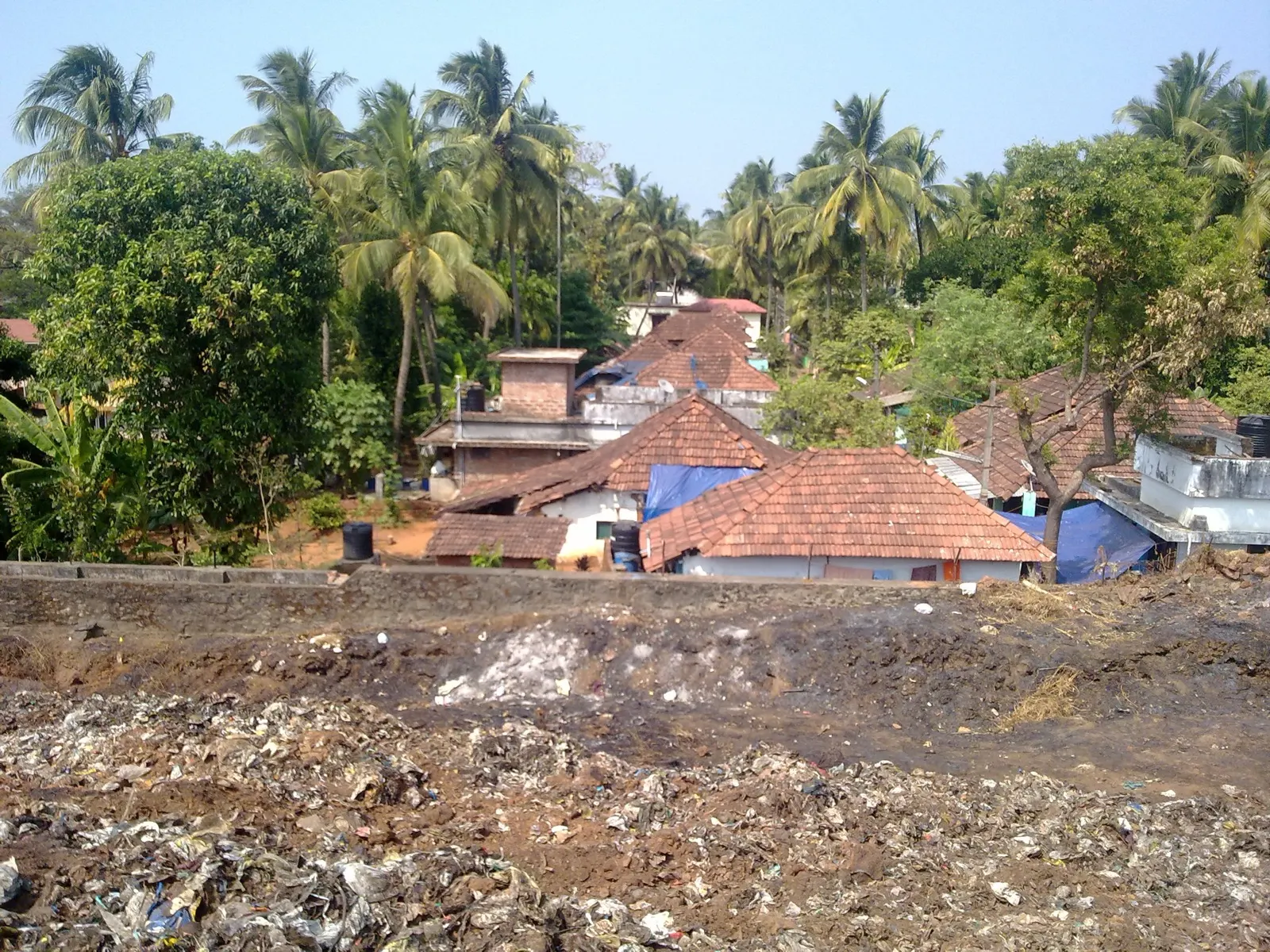
When the Corporation was formed in 2000, waste from the merged panchayats also began to arrive at Lalur, and the problem grew worse. Residents blocked the lorries again and again, and the Corporation’s schemes, from a sorting plant to an electric crematorium, did not solve the problem. The Lalur Anti-Pollution Action Committee then began a hunger strike that ran past a hundred days. Among those the book names at its head are T.K. Vasu, Aryan Nambudiri, C.P. Jose and Sunil Lalur. Writers such as Sukumar Azhikode and G. Kumarapillai backed the protest, and political and cultural groups across Kerala joined in.

Dumping at Lalur finally stopped while I.P. Paul was Mayor. Thrissur moved to decentralised waste processing. Kudumbashree groups took over collecting plastic, and smaller processing centres opened around the city. A new plant now stands at Lalur, and the old plastic buried in its soil is still being cleared.
A thread through the century
Many of these stories return to the same corner of Lalur. Gandhiji spoke at the colony beside the cemetery. C.R. Iyyunni, a leader of the 1936 electricity protest, raised the dump in the Council in 1942. Some seventy years later, the people living around it won the closure first promised in 1935.
Sources
- Joy Chiramel, Arranadu – Aranadu – Orunadu (2024), ch. 14
- Joy Chiramel, Arranadu – Aranadu – Orunadu (2024), ch. 12 (Lalur, the Mathaipuram colony and the trenching ground)
- Cochin Legislative Council, Proceedings, 11 December 1935, question 70, “Trenching Ground in Laloor” (Kerala Legislative Assembly archive, via the Internet Archive)
- Cochin Legislative Council, Proceedings, 26 May 1942, question 298, “Dumping ground at Lalur — transfer of” (Kerala Legislative Assembly archive, via the Internet Archive)
- Captain A.N. Menon, essay in Golden Jubilee Souvenir, Thrissur Municipality (1972), p. 189, as cited in Chiramel, ch. 14
Places and people in this story

The Lalur Trenching Ground
The land at Lalur where Thrissur dumped its waste for decades, and where residents fought a long campaign until the dumping stopped.

Dr John Matthai Centre, Lalur
The University of Calicut campus at Lalur, on the green estate where John Mathai lived, home to the Department of Economics and the School of Drama.

John Mathai
Economist and India's first Railway Minister, later Finance Minister, who made his home at Lalur in Aranattukara.

Chakkoru Master
Teacher, social worker and peacemaker (J.C. Chiramel), who taught Dalit children at Lalur, translated for Gandhiji and worked to heal the parish split.

Therattil J. Antony
Aranattukara's long-serving Congress councillor and Thrissur municipal chairman, remembered as Anthonichettan.

Jose Kattukkaran
Congress leader from Aranattukara who became the first Mayor of Thrissur Corporation in 2000.